
OEM/ODM
Contact Us
Tel: +86-537-6728868
E-Mail: chairman@sdrxsw.com
WhatsApp/Wetchat: +86 13562721377
Add: No.8 Wucun Industrial Park, Qufu,Shandong,China. 273100







Product Description
In 2024, a third-party lab test revealed that a popular "natural" energy gel brand delivered only 12.5g of carbohydrates per packet—while its label claimed 45g. That's 28% accuracy. Not a typo. Multiple production lots confirmed consistent under-labeling. The root cause? Active ingredient settling during gel filling—a structural flaw of the gel format that most manufacturers simply don't address.
This isn't an isolated scandal. It's a manufacturing problem that affects the entire pre workout gel category. And it's the first thing we check when a brand comes to us with a new gel formula.
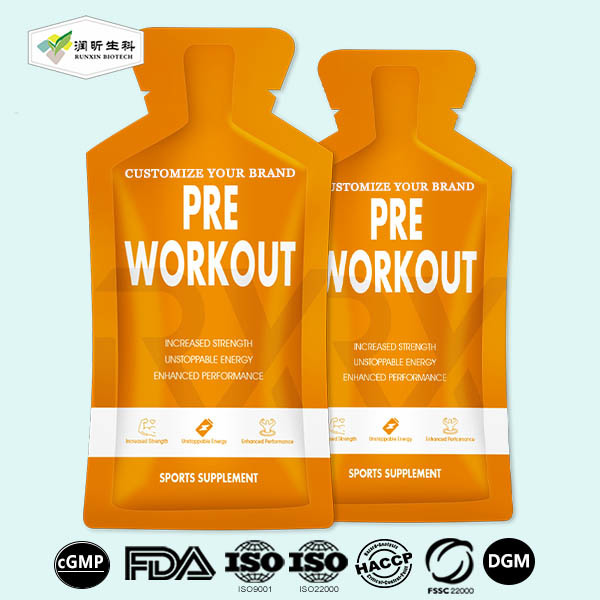
At Shandong Runxin Biotechnology, we've spent 28 years solving the problems that other contract manufacturers pretend don't exist. With 3,000+ brand partners and 6,000+ formulas in our library, we don't just fill gel packets—we engineer them for dose accuracy, gastrointestinal tolerance, and thermal stability from factory to finish line.
The Three Hidden Traps in Pre Workout Gel Manufacturing
Most OEM pages will tell you they offer "custom formulation" and "quality certifications." They won't tell you why your gel might fail in the field. Here are the three problems we solve before production even starts.
Trap #1: Dose Uniformity Failure
The problem: Pre workout gels are semi-solid matrices. When you mix 200mg caffeine, 6g citrulline malate, 3.2g beta-alanine, and electrolytes into a viscous gel base, the active ingredients don't stay evenly distributed. They settle. During filling, the first packet off the line might contain 120% of the target dose. The last packet might contain 60%.
This isn't theoretical. The Spring Energy scandal proved it: their "Awesome Sauce" gel delivered only 53–76 calories versus the labeled 180—across multiple production lots. FDA Class II nutrient standards require 80% minimum accuracy. They failed catastrophically.
Our solution:
- Suspension system design: We use hydrocolloid combinations (gellan gum + xanthan + modified starch) that create a thixotropic matrix—stable at rest, flowable during filling, then re-stabilizes immediately after dosing
- In-line viscosity monitoring: Real-time rheometry during the filling process detects viscosity deviations >5% and triggers automatic correction
- Multi-point sampling protocol: We test the first 10 units, middle 10, and last 10 of every filling run. Content uniformity must fall within ±8% of label claim—or the entire batch is reworked
Result: Our pre workout gels consistently hit 95–103% of labeled active content across the entire filling run.
Trap #2: Osmotic Pressure Ignorance
The problem: Pre workout formulas are dosed for effect, not for comfort. A typical pre workout gel packs 200–400mg caffeine, 6g citrulline malate, 3.2g beta-alanine, 1.5g betaine, and 300–500mg sodium into a 60ml sachet. That creates an osmotic pressure of 800–1,200 mOsm/L—far above the isotonic range of 270–330 mOsm/L.
When an athlete consumes a hyperosmotic gel mid-workout, water rushes into the gut to dilute the concentrated solution. Result: bloating, cramping, and urgent bathroom visits during a marathon or competition. This is the #1 complaint athletes report about energy gels, and it's almost entirely a formulation problem.
Our solution:
- Osmotic pressure calculation before formulation: We calculate the osmotic contribution of every ingredient before mixing. Caffeine anhydrous contributes ~12 mOsm per 200mg. Citrulline malate contributes ~50 mOsm per 6g. Sodium chloride contributes ~170 mOsm per 500mg. We map the total before a single gram is weighed
- Dual-carbohydrate matrix: We use a 1:0.8 glucose-to-fructose ratio (following the Jeukendup model) to maximize carbohydrate oxidation at 90g/hour while keeping osmotic load manageable
- Progressive-release design: For high-stim formulas, we layer fast-dissolving actives (caffeine, electrolytes) with slower-dissolving components (encapsulated citrulline) to spread osmotic load over 15–20 minutes instead of dumping it all at once
Result: Our standard pre workout gel formulations target 400–600 mOsm/L—hypotonic enough for rapid gastric emptying, concentrated enough to deliver effective doses in a 60ml format.
Trap #3: Thermal Degradation in the Field
The problem: Your gel is tested in a lab at 22°C. Your customer stores it in a gym bag at 35°C, a car trunk at 60°C, or a backpack in direct sun at 50°C+.
Gel matrices break down at different temperatures depending on the gelling agent:
- Gelatin: Softens at 35°C, liquefies at 60°C (140°F)
- Pectin: Stable to ~55°C, but requires pH 2.8–3.5 to gel properly—acidic conditions that destroy creatine and accelerate B-vitamin degradation
- Starch-based: Stable to ~50°C, but retrogradation causes texture hardening over time
Meanwhile, the active ingredients degrade at different rates:
- Caffeine sublimes above 50°C
- Thiamine (B1) degrades rapidly below pH 4.0 at elevated temperatures
- Citrulline becomes sticky and hygroscopic above 40°C
- Beta-alanine clumps and loses potency with moisture absorption
Our solution:
- Hybrid gelling system: We use pectin + modified starch + carrageenan combinations that maintain structural integrity to 62°C (145°F) while keeping pH at 4.2–4.5—safe for most actives while still providing proper gelation
- Post-cool active addition: The gel base is cooked at 85–90°C to dissolve hydrocolloids, then cooled to <55°C before actives are added. This prevents thermal degradation during manufacturing
- Accelerated stability testing at realistic conditions: We run stability chambers at 40°C/75% RH for 6 months (simulating 2 years shelf life) AND at 50°C/60% RH for 3 months (simulating car trunk / gym bag conditions). Any formula that fails the 50°C test is reformulated—not released
Result: Our pre workout gels maintain >90% active potency after 18 months at 25°C, and >85% after 3 months at 50°C—conditions that would destroy most competing products.
Product Specifications
Parameter | Details |
Active Ingredients | Caffeine, Citrulline Malate, Beta-Alanine, Betaine, Taurine, Electrolytes, B-Vitamins, Adaptogens |
Dosage Range | 30–60ml per sachet/pouch |
Gel Base | Pectin / Gelatin / Hybrid hydrocolloid system |
Shelf Life | 18–24 months (standard); validated to 50°C stress conditions |
Packaging | Stick pack (30–60g), spout pouch, sachet |
Certifications | ISO9001, ISO22000, FSSC22000, GMP, FDA, HALAL, SC, REACH, ECOCERT |
Annual Capacity | 100M+ sachets/pouches |
MOQ | 50,000 units |
Lead Time | 30–45 days (after formula approval) |
Customization Options
Formula & Active Profile:
- Stimulant level: stim-free / low (100mg caffeine) / moderate (200mg) / high (300–400mg)
- Performance focus: endurance (carb-heavy), strength (creatine + beta-alanine), focus (nootropic blend), or all-around
- Electrolyte matrix: sodium/potassium/magnesium ratios customized for target sport and climate
- Sweetener system: sucrose, sucralose, stevia, monk fruit, or erythritol—each with different osmotic and stability implications
Gel Base & Texture:
- Vegan pectin system (plant-based, clean label)
- Gelatin system (traditional texture, lower cost)
- Hybrid system (our recommended approach—best heat stability and texture balance)
- Texture options: firm gel, soft gel, chewable, or quick-dissolve
Flavor Engineering:
- 30+ flavor profiles tested in gel matrix (citrus, berry, tropical, coffee, chocolate)
- Bitterness masking via cyclodextrin complexation and microencapsulated flavor oils
- pH-balanced for both taste and active stability (target pH 4.2–4.5)
Packaging:
- Easy-tear stick packs (30–60g): classic format for running belts and cycling jersey pockets
- Spout pouches: resealable for larger servings
- Nitrogen-flushed individual sealing available for extended shelf life
- Custom branding, pouch printing, and box packaging
How We're Different: Us vs. Market Standard
Dimension | Market Standard | Runxin Approach |
Dose Uniformity | Single-point sampling (first 3 units only) | Multi-point protocol: first 10 + middle 10 + last 10 per run; ±8% tolerance |
Osmotic Pressure | Not calculated; ingredients dosed for label impact | Calculated before formulation; target 400–600 mOsm/L for GI tolerance |
Thermal Stability | Tested at 25°C only; no stress testing | Dual protocol: 25°C/18 months + 50°C/3 months (simulates real-world storage) |
Preservative System | Sodium benzoate (cheap; risks benzene formation with amino acids) | Natamycin at 5–10 ppm + strict water activity control (<0.55) |
Active Addition | All ingredients added during hot cook (85°C+) | Post-cool addition: actives added at <55°C to prevent thermal degradation |
Gel Base | Single gelling agent (gelatin OR pectin) | Hybrid system (pectin + modified starch + carrageenan) stable to 62°C |
Stability Testing | Accelerated only (40°C/75% RH) | Accelerated + stress testing (50°C) for real-world validation |
Pre Workout Gel Ingredient Compatibility Guide
Not all pre workout ingredients play well together in a gel matrix. Here's our compatibility framework based on 28 years of formulation experience:
Ingredient | Gel Compatibility | Key Challenge | Our Solution |
Caffeine Anhydrous | Good | Bitterness; sublimes >50°C | Cyclodextrin complexation (reduces bitterness 60–70%); post-cool addition |
Citrulline Malate | Moderate | Sour + bitter taste; hygroscopic | pH buffering to 4.3; encapsulation for moisture protection |
Beta-Alanine | Moderate | Persistent bitter aftertaste; clumping | Sequential flavor release system; controlled humidity during filling |
Creatine Monohydrate | Poor | Degrades at pH <4.0; converts to creatinine in moisture | Only used in pH >4.2 gel systems; monohydrate form with low water activity |
Electrolytes (Na, K, Mg) | Good | Metallic taste; increases osmotic pressure | Chelated mineral forms (better taste, lower osmotic contribution) |
B-Vitamins (B6, B12, Thiamine) | Poor | Thiamine degrades rapidly at pH <4.0 + heat; B12 light-sensitive | Post-cool addition; opaque packaging; pH kept >4.2 |
Adaptogens (Rhodiola, Ashwagandha) | Good | Earthy taste; variable solubility | Standardized extracts with microencapsulation for taste masking |
BCAAs | Poor | Intense bitterness + burning sensation; water activity issues | Only in low-dose formulas; heavy flavor masking required |
Formulation Strategy by Use Case
Endurance Athletes (Running, Cycling, Triathlon)
- Priority: Sustained energy, GI tolerance, electrolyte replacement
- Target: 30–45g carbs per 60ml serving, 200–300mg sodium, 100–200mg caffeine
- Osmotic target: 300–400 mOsm/L (near-isotonic for fastest gastric emptying)
- Recommended gel base: Hybrid (pectin + modified starch) for heat stability during long events
Strength & Power Athletes (Weightlifting, CrossFit, HIIT)
- Priority: Focus, pump, power output
- Target: 200–400mg caffeine, 6g citrulline malate, 3.2g beta-alanine, 1.5g betaine
- Osmotic target: 500–600 mOsm/L (acceptable for pre-workout consumption 20 min before training, not during)
- Recommended gel base: Hybrid or pectin (firm texture, quick consumption)
Stim-Free / Evening Training
- Priority: Pump and focus without sleep disruption
- Target: 0mg caffeine; 6g citrulline malate; 2g beta-alanine; nootropic blend (L-tyrosine 1g, alpha-GPC 300mg)
- Osmotic target: 400–500 mOsm/L
- Recommended gel base: Pectin (vegan, clean label appeal)
Quality Assurance
Our pre workout gel manufacturing follows a 5-stage quality protocol:
- Raw Material Verification: Every ingredient tested for identity (FT-IR), potency (HPLC), heavy metals (ICP-MS), and microbiological safety before release from quarantine
- Bench-Scale Trial: 5kg batch produced and tested for texture, taste, active content, and osmotic pressure before scaling
- Pilot Batch: 50kg batch on production equipment to validate filling accuracy, gel structure, and stability under real manufacturing conditions
- Production Run: In-line monitoring of viscosity, fill weight, and gel temperature. Multi-point dose uniformity testing (first/middle/last units)
- Finished Product Testing: Full panel testing—active content, microbiology, heavy metals, texture, taste, osmotic pressure, and accelerated stability
All testing is conducted in our ISO-certified in-house lab. Third-party verification (NSF, Informed Sport, Eurofins) available for brands targeting competitive athletes.
Frequently Asked Questions
Q: Why do some pre workout gels have inconsistent effects batch to batch?
A: The root cause is usually dose uniformity failure during filling. Active ingredients settle in the gel matrix, causing the first packets off the line to contain more actives than the last. This is why we use multi-point sampling (first 10, middle 10, last 10 units per run) with a ±8% tolerance. If a batch fails uniformity testing, it's reworked—not shipped. The Spring Energy scandal (28% label accuracy) proved what happens when manufacturers skip this step.
Q: Can you make a pre workout gel that doesn't cause stomach issues during training?
A: Yes, and it starts with osmotic pressure calculation. Most manufacturers dose ingredients for label impact without calculating the osmotic contribution of each component. A typical pre workout gel can reach 800–1,200 mOsm/L—far above the isotonic range (270–330 mOsm/L). We calculate osmotic pressure before formulation and target 400–600 mOsm/L for pre-workout gels. We also use a dual-carbohydrate matrix (glucose:fructose 1:0.8) and chelated mineral forms to reduce osmotic load while maintaining effective doses.
Q: How do you ensure the gel doesn't melt or degrade in hot conditions?
A: We use a hybrid gelling system (pectin + modified starch + carrageenan) that maintains structural integrity to 62°C—compared to gelatin which liquefies at 60°C and pectin alone which requires very acidic conditions (pH 2.8–3.5). We also validate stability at 50°C for 3 months, simulating car trunk and gym bag conditions. If a formula fails at 50°C, we reformulate—we don't ship it. This stress testing is rare in the industry; most manufacturers only test at 25°C.
Q: What's the difference between your preservative system and standard industry practice?
A: Most manufacturers use sodium benzoate (0.1–0.3%) because it's cheap and effective. But sodium benzoate reacts with L-arginine and L-citrulline—two common pre workout ingredients—to form benzene, a known carcinogen. Ascorbic acid accelerates this reaction. We use natamycin (5–10 ppm) combined with strict water activity control (Aw <0.55) and modified atmosphere packaging. It costs 3–5x more than sodium benzoate, but it eliminates the benzene formation risk entirely.
Q: What's the MOQ for custom pre workout gel?
A: Our standard MOQ is 50,000 units (sachets or pouches). For first-time clients, we offer a trial batch option at reduced volume to validate the formula before full production commitment.
Q: How long does development take from formula to finished product?
A: Formula development and bench samples take 5–15 days. Flavor trials and optimization take 10–20 days. Stability testing runs in parallel (accelerated protocol, 4–6 weeks for preliminary data). Mass production takes 20–35 days after formula approval. Total timeline: approximately 8–12 weeks from project kickoff to first shipment.
Ready to Build Your Pre Workout Gel?
Most contract manufacturers will quote you a price and promise "custom formulation." Few will tell you why your gel might fail in the field—or how they prevent it.
We've spent 28 years solving the problems that cause product recalls, athlete complaints, and brand damage. From dose uniformity to osmotic pressure to thermal stability, every detail is engineered before production starts.
Contact us today to discuss your pre workout gel project. Send us your target formula or your performance goals—we'll respond within 24 hours with a technical assessment and feasibility analysis.
Related articles:
- Liquid Supplement Manufacturing
- Choosing a Liquid Supplement Manufacturer
- Types of Liquid Supplements: Syrups, Drops, Shots & Beverages
- Herbal & Botanical Liquid Supplement Manufacturing
- Quality and Compliance in Liquid Dietary Supplement Manufacturing
Related Products:
Get a Free Quote
If you need more information about our products, please feel free to contact us, we will provide you with professional service personnel, we will reply promptly after receiving the information.
FAQ
Q
Can you customize product formulations based on cross-border market demands?
A
Absolutely, we can tailor product formulations to meet local consumer preferences and regulatory requirements in your target markets.
Q
Can you provide multilingual labeling and instructions for cross-border products?
A
Certainly, we offer multilingual labeling and instructions to ensure accurate communication of product information in different countries' markets.
Q
What is the MOQ for cross-border business?
A
Our cross-border business MOQ is low, typically ranging from 1000 to 5000 units of products, and can be flexibly adjusted based on specific circumstances.
Q
Can you directly ship to overseas warehouses or facilitate split shipments?
A
We support direct delivery to overseas warehouses and can arrange split shipments according to your needs. We have well-established global logistics solutions.
Q
Do you support commonly used payment methods for cross-border markets?
A
Yes, we support widely used cross-border payment settlement methods such as PayPal, credit cards, and TT bank transfers.
Q
Can you provide import customs clearance documents for major countries?
A
Yes, we can provide customs registration information, inspection reports, and other customs clearance documents for different countries.
Q
Does your product packaging design comply with regulatory requirements in major countries?
A
Our product packaging design can be adjusted to meet the regulatory standards and requirements of different countries, ensuring compliance with local norms.
Q
Can you conduct small-scale production for cross-border testing?
A
Certainly,we welcome small-scale trial orders. We have dedicated small-scale production lines available for cross-border market testing,assisting you in evaluating market potential and feedback.

Tel: +86-537-6728868
E-Mail: chairman@sdrxsw.com
WhatsApp/Wetchat: +86 13562721377
Add: No.8 Wucun Industrial Park, Qufu,Shandong,China. 273100