
OEM/ODM
Contact Us
Tel: +86-537-6728868
E-Mail: chairman@sdrxsw.com
WhatsApp/Wetchat: +86 13562721377
Add: No.8 Wucun Industrial Park, Qufu,Shandong,China. 273100




Product Description
Here's a question that makes most shilajit OEM pages uncomfortable: if a brand tells you their product has "80% fulvic acid," what are you actually paying for?
The answer might surprise you. There is no industry-mandated standard method for measuring fulvic acid in shilajit. Different labs use UV-Vis spectrophotometry, HPLC, the Verploegh/Brandvold fractionation method, or CDFA agricultural humate protocols — and each produces results that are not directly comparable. A 70% reading by one method tells you almost nothing about how the same product would test under a different method. Worse, fulvic acid derived from agricultural leonardite (oxidized lignite coal) can pass the same tests as genuine shilajit-derived fulvic acid. The test measures molecules — it doesn't ask where they came from.
At Shandong Runxin Biotechnology, we've spent 28 years in contract manufacturing, and we've watched the shilajit market grow into a $105M+ global industry plagued by an authenticity crisis. We built our shilajit resin supplement line on a different principle: prove it or don't sell it. This page explains exactly what that means for your brand.
Product Specifications
Parameter | Details |
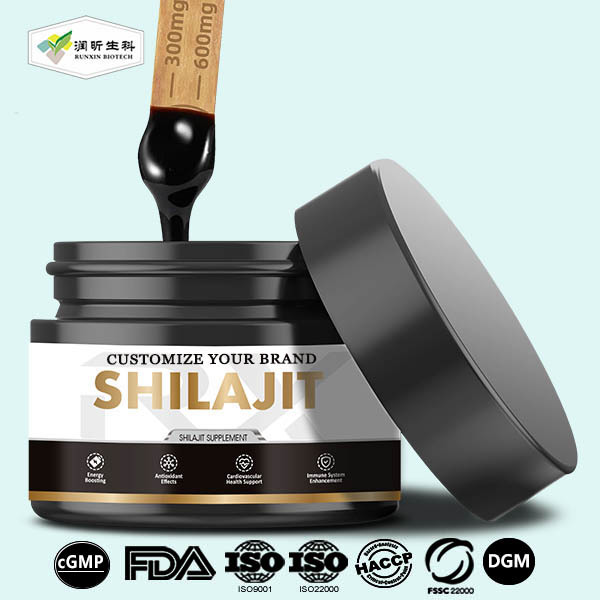
Active Ingredient | Purified Shilajit Resin (Asphaltum punjabianum) |
Form | Semi-solid resin paste |
Fulvic Acid | ≥40% (Verploegh/Brandvold method, ISO 17025 lab) |
Dibenzo-alpha-pyrones (DBPs) | ≥0.3% (HPLC verified — authenticity marker) |
Dosage | 300mg–600mg per serving (pea-sized portion) |
Serving Size | 1 applicator/spoon per day |
Shelf Life | 24–36 months (stored in cool, dry conditions) |
Packaging | Glass jar (5g/10g/15g/30g/50g), or custom |
Certification | ISO9001, ISO22000, FSSC22000, GMP, FDA-registered, HALAL |
MOQ | 50,000 bottles |
Why Fulvic Acid Percentage Is Not What You Think
Every shilajit brand advertises fulvic acid content. Almost none explain the testing problem behind that number.
Fulvic acid is not a single molecule — it's a heterogeneous family of low-molecular-weight organic acids. The chemical composition varies depending on biological feedstock, geological environment, and deposit age. Shilajit fulvic acid from the Himalayas is chemically distinct from fulvic acid derived from North American leonardite. They share structural similarities but are not identical compounds.
Here are the four methods labs commonly use, and why they produce incomparable results:
Method | Designed For | Specificity | Cross-Method Comparability |
UV-Vis Spectrophotometry | General organics | Low–Medium | Poor |
HPLC | Chemical separation | High (if validated) | Poor (no universal standard) |
Verploegh/Brandvold | Humic substances | Medium–High | Poor vs. UV-Vis |
CDFA HA4/JC | Agricultural humates | Medium (for that matrix) | Poor for shilajit |
When a brand advertises "80% fulvic acid" without naming the lab, the method, and the batch — that number is not a verifiable claim. It's marketing.
The Three Markers That Actually Prove Authenticity
Instead of chasing a single percentage number, we verify shilajit authenticity through three independent markers that cannot be faked or substituted:
1. Dibenzo-alpha-Pyrones (DBPs) — The Fingerprint
DBPs are organic compounds formed exclusively through the geological transformation processes that create authentic shilajit. They do not exist in agricultural leonardite, peat, or any synthetic substitute. If a shilajit product lacks documented DBP content, there is no pharmacological certainty that it contains genuine shilajit.
The landmark clinical trial on shilajit and testosterone (Andrologia, 2016) specifically standardized to ≥0.3% DBPs. We match or exceed this threshold in every batch, verified by HPLC.
2. ICP-MS Heavy Metal Panel — The Safety Baseline
Raw shilajit naturally accumulates heavy metals during geological formation — lead, mercury, arsenic, cadmium, aluminum, chromium, and thallium. Fulvic acid is a powerful carrier molecule: it binds to minerals and transports them into cells. But it doesn't discriminate between beneficial minerals and toxic metals. This is the "Heavy Metal Paradox" — the same mechanism that makes high-quality shilajit bioavailable also makes contaminated shilajit dangerous.
We test every batch using ICP-MS (Inductively Coupled Plasma Mass Spectrometry), detecting contaminants at the parts-per-billion level. Full COAs with actual measured values — not just "pass/fail" — are available for your regulatory submissions.
3. Altitude-Verified Sourcing — The Origin Story
Altitude is the single biggest factor separating therapeutic-grade shilajit from ordinary resin. At 14,000–16,000 feet, oxygen levels drop sharply (hypobaric hypoxia), forcing anaerobic decomposition that preserves bioactive molecular chains. The result: low-molecular-weight fulvic acid (~5.1 kDa) that can cross biological barriers efficiently, versus the heavier molecules (~8 kDa) produced at lower altitudes.
Below 12,000 feet, shilajit is exposed to industrial atmospheric runoff, agricultural groundwater seepage, and higher baseline contamination. We source exclusively from verified high-altitude locations and maintain full chain-of-custody documentation.
Resin vs. Powder vs. Extract: What Form Should Your Brand Sell?
Not all shilajit forms are equal. Understanding the differences helps you choose the right product format for your target market:
Attribute | Resin | Powder | Capsules | Liquid Drops |
Processing | Minimal — purified and dried | Spray-dried or freeze-dried resin | Powder filled into capsules | Dissolved in carrier |
Fulvic Acid Retention | Highest (minimal heat exposure) | Reduced if heat-dried | Depends on powder quality | Variable |
Authenticity Risk | Lowest — hard to fake the texture | High — easy to substitute | High — consumer can't inspect | Medium |
Consumer Convenience | Lowest — requires dissolving | Medium — mixes into drinks | Highest — ready to take | High — dropper dosing |
Shelf Stability | Excellent (years) | Good (moisture sensitive) | Good | Shorter (oxidation risk) |
Best For | Premium/ayurvedic audience | Mass market, blending | Convenience-first brands | Active lifestyle brands |
Our recommendation: if you're building a premium brand, start with resin. The texture, smell, and dissolution behavior are inherently difficult to counterfeit, giving your customers built-in verification. Add capsules or liquid drops later as line extensions.
Customization Options
Sourcing Origin: Himalayan (Nepal/India), Altai Mountains — altitude-verified with documentation
Purification Method: Traditional Triphala Shodhana, modern centrifugation + ultrafiltration, or combined approach
Fulvic Acid Standardization: 40%+, 50%+, 60%+ (with method-specified COA)
Form: Pure resin paste, resin in glass jar, pre-portioned applicator, capsule fill, liquid suspension
Packaging: Glass jar (5g–50g), HDPE jar, sachet, dropper bottle, custom packaging design
Labeling: Full private label — your brand, your design, your supplement facts panel
Certifications: GMP, FDA-registered facility, ISO9001/22000, FSSC22000, HALAL, Kosher available
Our Purification Process: Ancient Wisdom Meets Modern Science
The gap between raw shilajit and a safe, potent supplement is purification. Here's how we do it:
Step 1 — Raw Material Assessment: Each batch is tested for initial heavy metal levels, moisture content, and visual quality before entering the purification line.
Step 2 — Dissolution & Filtration: Raw shilajit is dissolved in purified water and passed through multi-stage filtration to remove rock fragments, sand, and macro-particles.
Step 3 — Centrifugation: High-speed centrifugal separation removes dense impurities (mineral particles, heavy metal clusters) without thermal damage to bioactive compounds.
Step 4 — Ultrafiltration: Membrane filtration at 0.01–0.1 micrometer pore size removes fine particulates and unwanted residues while preserving fulvic acid and DBP integrity.
Step 5 — Low-Temperature Concentration: Moisture is removed under vacuum at controlled temperatures (below 60°C) to prevent degradation of heat-sensitive peptides and enzymes.
Step 6 — Final Standardization & Testing: The purified resin is standardized to target fulvic acid and DBP levels, then subjected to full ICP-MS heavy metal panel, microbiological testing, and identity verification before release.
Us vs. Market Standard: A Comparison
Quality Dimension | Market Standard | Runxin Approach |
Fulvic acid claim | "60-80%" (method unspecified) | Stated with lab, method, batch, and accreditation |
Authenticity marker | None — relies on FA% alone | DBP content verified by HPLC (≥0.3%) |
Heavy metal testing | "Lab tested" (no data shared) | Full ICP-MS COA with actual measured values |
Sourcing transparency | "Himalayan" (no altitude specified) | Altitude-verified with chain-of-custody |
Purification | Basic filtration or heat treatment | Multi-stage: centrifuge + ultrafiltration + low-temp vacuum |
Drying method | Fire-drying (fast, damages bioactives) | Vacuum concentration below 60°C |
COA availability | Generic template per product | Batch-specific with detection limits |
Compliance Note: What You Can and Cannot Say
As a dietary supplement, shilajit products must follow specific labeling regulations. Here are common compliance pitfalls we help our partners avoid:
❌ What You Cannot Say | ✅ What You Can Say |
"Cures fatigue" | "Supports natural energy levels" |
"Boosts testosterone" | "Supports healthy testosterone levels" |
"Detoxifies the body" | "Supports the body's natural wellness" |
"Treats joint pain" | "Supports joint comfort and mobility" |
"Anti-aging" | "Supports cellular health and vitality" |
"100% pure" (without data) | "Verified by batch-specific ICP-MS testing" |
Our regulatory team reviews all label claims before production to ensure your product launches without compliance issues.
Frequently Asked Questions
Q: Why don't you advertise a specific fulvic acid percentage like other brands?
A: Because a percentage without method context is misleading. The same shilajit sample tested by UV-Vis, HPLC, or Verploegh/Brandvold will produce different numbers — and agricultural fulvic acid can pass the same tests as genuine shilajit. We publish full COAs with the lab name, method, accreditation, and batch number so you can verify the data independently. Genuine purified Himalayan resin typically lands between 15–22% by USP/Lamar method, or 40–60%+ by Verploegh/Brandvold. Numbers above 70% should be questioned.
Q: What are dibenzo-alpha-pyrones (DBPs) and why do they matter?
A: DBPs are organic compounds unique to authentic shilajit — they cannot be found in agricultural humates, synthetic fulvic acid, or any substitute material. Their presence is the single most reliable chemical confirmation that a product contains genuine shilajit. The key clinical trial on shilajit used material standardized to ≥0.3% DBPs. We verify DBP content by HPLC for every batch.
Q: How do you ensure heavy metal safety?
A: Every batch undergoes ICP-MS (Inductively Coupled Plasma Mass Spectrometry) testing, which detects lead, mercury, arsenic, cadmium, thallium, and other contaminants at parts-per-billion levels. We provide full COAs with actual measured values — not just pass/fail results. High-altitude sourcing (14,000ft+) gives us a clean starting material with naturally lower baseline contamination before purification even begins.
Q: Can you provide shilajit in capsule or gummy form instead of raw resin?
A: Yes. We offer full OEM/ODM across multiple formats: pure resin paste, pre-portioned resin in jars, capsules (gelatin or vegetarian), gummies, and liquid drops. Each format has different trade-offs in authenticity verifiability and consumer convenience. We recommend resin for premium positioning, with capsules or gummies as line extensions.
Q: What is your MOQ for custom shilajit resin products?
A: Our minimum order quantity is 50,000 bottles for private label production. Sample batches are available for formula development and market testing before full production commitment.
Q: What's the lead time for a custom shilajit resin order?
A: Sample preparation takes 5–7 business days. Bulk production typically requires 15–25 business days depending on order volume, packaging complexity, and certification requirements. We recommend allowing additional time for custom packaging and label approval.
Q: Is your shilajit sourced from Himalayan or Altai regions?
A: We source from verified high-altitude locations in both the Himalayan and Altai mountain ranges. Each batch comes with altitude documentation and chain-of-custody records. We can discuss sourcing preferences based on your target market's expectations and the specific mineral profile you're aiming for.
Ready to Build a Shilajit Brand You Can Actually Defend?
The shilajit market is growing fast — but so is the scrutiny. Regulatory agencies in the UK, EU, and US are tightening enforcement on heavy metals and authenticity claims. Brands that can prove their quality with batch-specific ICP-MS data, DBP verification, and altitude documentation will win. Brands that rely on vague "pure Himalayan" claims will face recalls, lawsuits, or marketplace removals.
With 28 years of contract manufacturing experience, 3,000+ brand partners, and 6,000+ formula archives, we have the infrastructure and expertise to help you build a shilajit product line that's both commercially successful and scientifically defensible.
Contact us today to discuss your custom shilajit resin supplement project. Our team responds within 24 hours with a tailored proposal.
Shandong Runxin Biotechnology Co., Ltd.
28 Years | 3,000+ Brand Partners | 6,000+ Formulas
ISO9001 · ISO22000 · FSSC22000 · GMP · FDA · HALAL
Related articles:
- Choosing a Liquid Supplement Manufacturer
- Types of Liquid Supplements: Syrups, Drops, Shots & Beverages
- Herbal & Botanical Liquid Supplement Manufacturing
- Quality and Compliance in Liquid Dietary Supplement Manufacturing
Related Products:
Get a Free Quote
If you need more information about our products, please feel free to contact us, we will provide you with professional service personnel, we will reply promptly after receiving the information.
FAQ
Q
Can you customize product formulations based on cross-border market demands?
A
Absolutely, we can tailor product formulations to meet local consumer preferences and regulatory requirements in your target markets.
Q
Can you provide multilingual labeling and instructions for cross-border products?
A
Certainly, we offer multilingual labeling and instructions to ensure accurate communication of product information in different countries' markets.
Q
What is the MOQ for cross-border business?
A
Our cross-border business MOQ is low, typically ranging from 1000 to 5000 units of products, and can be flexibly adjusted based on specific circumstances.
Q
Can you directly ship to overseas warehouses or facilitate split shipments?
A
We support direct delivery to overseas warehouses and can arrange split shipments according to your needs. We have well-established global logistics solutions.
Q
Do you support commonly used payment methods for cross-border markets?
A
Yes, we support widely used cross-border payment settlement methods such as PayPal, credit cards, and TT bank transfers.
Q
Can you provide import customs clearance documents for major countries?
A
Yes, we can provide customs registration information, inspection reports, and other customs clearance documents for different countries.
Q
Does your product packaging design comply with regulatory requirements in major countries?
A
Our product packaging design can be adjusted to meet the regulatory standards and requirements of different countries, ensuring compliance with local norms.
Q
Can you conduct small-scale production for cross-border testing?
A
Certainly,we welcome small-scale trial orders. We have dedicated small-scale production lines available for cross-border market testing,assisting you in evaluating market potential and feedback.

Tel: +86-537-6728868
E-Mail: chairman@sdrxsw.com
WhatsApp/Wetchat: +86 13562721377
Add: No.8 Wucun Industrial Park, Qufu,Shandong,China. 273100